We need to think deeply and responsibly about the spatial internet. The design of digital experiences requires serious recalibration.
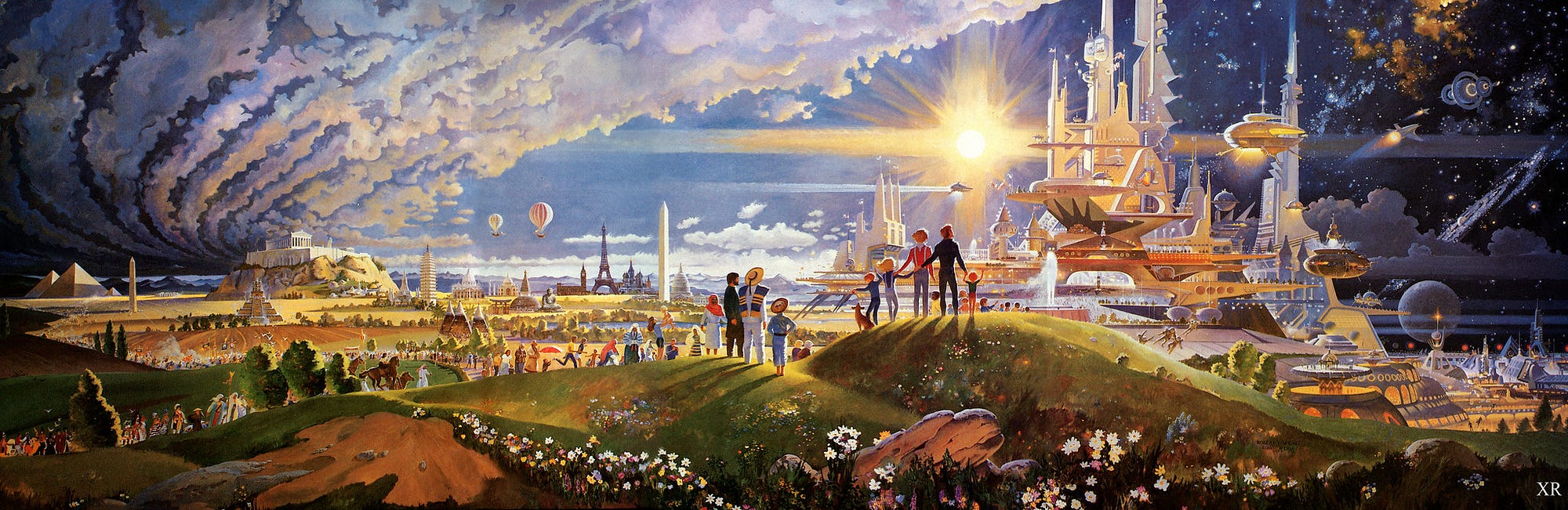
“Humanity today is like a waking dreamer, caught between the fantasies of sleep and the chaos of the real world. The mind seeks but cannot find the precise place and hour. We have created a Star Wars civilization, with Stone Age emotions, medieval institutions, and godlike technology. We thrash about. We are terribly confused by the mere fact of our existence, and a danger to ourselves and to the rest of life.”
― Edward O. Wilson, The Social Conquest of Earth
During the pandemic, our lives have been accelerated into the digital. By necessity, work, shopping, and socializing are all online now, and it sometimes feels as if we are halfway into a metaverse already.
We’re not.
Metaverse Is The New Reality. No, Really!

Neal Stephenson invented the concept in his dystopian novel Snow Crash. But the metaverse of Snow Crash was satire at its finest — the main character, called Hiro Protagonist(!), is a cyber ninja who delivers pizza for the mafia, and the US is a wasteland destroyed by hyperinflation.
Ernest Kline’s Ready Player One imagined a metaverse, or, as it’s called in the book, the “OASIS”. Kline is a kid of the seventies and eighties, and his vision of a digital hangout place is escapist and heavily nostalgic, much like most mainstream pop culture today.
The Matrix is by far the darkest vision of what a digital reality would look like — a drab, lifeless world where the consciousness of the human race is enslaved to relive the same era forever.
The metaverse concept clearly inspired different visions by different authors. Satire, nostalgia, and dystopia are just some of the simplified settings writers, and filmmakers were inspired to create.
The one quietly being built is something else entirely. And I’m not talking about Meta (even Keanu Reeves is roasting Mark Zuckerberg for trying to corporatize the metaverse). During Covid, we’ve ingrained some bad habits — spending even more time being by ourselves. Doing more of the same can only make matters worse. It’s not healthy for the mind OR the body.
The metaverse could be anything from a form of escapism as an alternative to a mundane reality or a total viper pit of misinformation and abuse of privacy rights. Make no mistake, companies like Meta will further monetize consumers. You can scroll infinitely down the list of misused inventions.
You’re Pushing Our Buttons
Passively sitting in traffic or waiting for a friend, our attention is hijacked by a steady drip of dopamine as we scroll away endlessly on social media, without ever needing to hit “refresh”, “next page”, or any other button.
Aza Raskin, the inventor of infinite scroll function, admitted it was not designed to help a user but to keep them online for as long as possible deliberately. Now he regrets creating it.
We are being optimized for the extraction of our attention.
Our minds are already in a different mental space than physical space.
Our attention is a commodity that resides in a brain evolved for survival and constant caution. This wetware of ours is the most complex structure we have discovered in the known universe so far, and yet, we are slaves to its default mode — a constant state of panic.
The promise of technology is to help us reduce dangerous, menial, repetitive tasks, help us connect, and, on the other end of the spectrum, improve daily life quality.
In a way, technology is supposed to help us have a fulfilling time, as opposed to just filling our time.
Recalibrate Your Vision
There have been beautiful, enriching virtual experiences beyond gaming, and we can safely say that more complex virtual worlds already exist.
An alternative personality in a virtual world has already been adopted by kids. For instance, my partner’s sons outfit their avatars with Air Jordans they can’t get in the real world. They regularly log into Fortnite to grab the latest skin and get limited-time-offer emotes. They express themselves freely, flex, exchange ideas and creativity, build up their emotional intelligence, and hang out with multitudes of their peers. It just may be that the metaverse provides another essential component of socializing and growing up.
I’ve spent hours buying tickets for flights, though. The dark patterns, features of interface design crafted to trick you into doing something you don’t want to do are one of my personal grievances. I’ve also spent countless hours endlessly scrolling through my socials, catching myself and vowing to never do it again more times than I’d like to admit. And the time I want to spend with my family, partner, and friends always seems out of reach.
As self-critical as I can get, I don’t think this is my own fault or a time-planning fallacy.
The design of digital experiences requires serious recalibration.
Are You Seeing What I’m Seeing?

We must think deeply and responsibly about the inevitable ever-present spatial internet, one with personalized digital experiences that span the physical and virtual worlds. Instead of a clear-cut divide between material and digital, what we call real is actually becoming a spectrum ranging from physical to virtual.
Right now, you are reading and dividing your attention between this screen and the space you’re in. A part of you is online, and a part of you isn’t.
Doesn’t feel like a division, does it?
Your reality is augmented, but there’s no violent transition in your experience. It’s seamless. Or at least, it feels seamless, cause it’s what most people accept as normal. I am convinced a significant chunk of our time will be spent in some form of augmented reality. Soon, spatial computing will be a normal part of daily life. And in it, virtual entities will provide a sense of intersubjectivity, give you information, offer advice and commentary on matters relevant to you in both virtual and material spaces. These facets of reality will not compete but, instead, enhance each other.
There will be different layers of realities that we can all be experiencing, even in the same environment or physical space.
Extended reality has a unique way of influencing our emotions, similar to how music can change our mood. This technology allows us to enter different environments that can make us feel by engaging our senses in a way that’s akin to, but much more intense than, listening to music.
As we move through these virtual spaces, the line between what’s real and what’s digital is starting to blur. XR doesn’t just change our view of the world; it changes our emotional experience in it, leading to new possibilities for creating spaces that understand and respond to our emotions better.
Spatial computing will allow us to create a canvas for our collective imagination, inviting us to not only reimagine our current realities but to actively shape them. It challenges us to think beyond the confines of our immediate surroundings and to envision a future where our digital and physical realms enhance each other, leading to unprecedented levels of creativity, understanding, and connectivity.
XR promises a future where the boundaries of what is possible are continually redrawn, heralding a new chapter in human advancement, one where we will not be clicking at all.
 Damir First
Leave a comment